
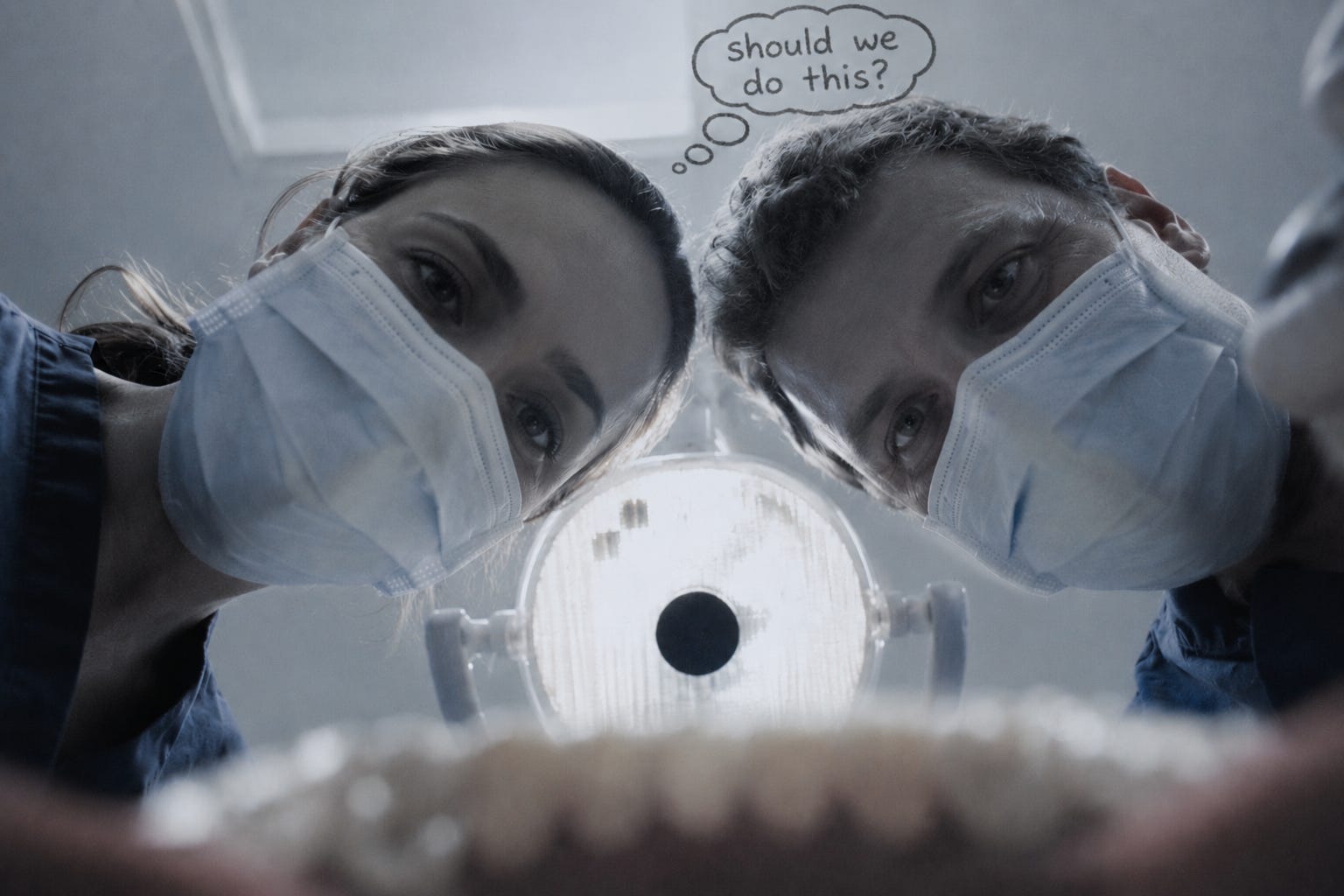
I hadn’t been to the dentist in six years.
I finally went two months ago. Checkup, cleaning, the whole thing. My family dentist, a very nice Russian lady. She hasn’t seen me in six years, so she asks how everything is going. I told her I got a little hairier and maybe a little less funny. She laughed. It was fine. It was chill.
Then she found a root canal.
I didn’t even fully know what that meant. She explained the procedure, ran the insurance, and told me my out of pocket would be over a thousand dollars. I went home, told my parents, and watched their faces do the thing faces do when something is serious. That’s when it started to feel real.
But here’s the part that actually broke my brain.
My mom looked at me and said: “Maybe go to a different dentist and see if you actually need it.”
I stopped. What do you mean, if I need it? A credentialed professional just looked in my mouth and told me I need a root canal. Why would a different dentist say something different? And why is “get a second opinion” just... normal advice? Why do we say that like it’s obvious?
Because what it actually means is: experts can look at the same mouth and disagree. Experts can look at the same X-ray and reach different conclusions. And we’ve all just quietly accepted this. We say “get a second opinion” the same way we say “drive safe.” It’s so normal nobody stops to notice how insane it is.
Here is the position that puts you in.
You are not a dentist. You don’t have the degree, the training, or the time to fact-check someone who does. That’s the whole reason you went. And now you’re being told that trusting the expert isn’t enough. You have to somehow evaluate the expert. But you don’t have the tools to do that. So you can’t just trust, and you can’t verify. You’re stuck in the middle with your mouth open.
Most people do what I did. You take the hit. You pay the money. You do the procedure. Not because you believe it’s right, but because the alternative costs something you can’t afford: your time. Your attention. Your life. You’ve got work, relationships, things that matter. You can’t spend three weeks shopping dentists to confirm a root canal. So you consent. Not out of trust. Out of exhaustion.
The data is not comforting.
A 2017 study at the Mayo Clinic found that 21% of patients who sought a second opinion left with a completely new diagnosis. Not a refined one. A different one. In a separate national review of nearly 7,000 second opinions across multiple specialties, 37% resulted in recommended changes to treatment. And when doctors were surveyed about their own industry -- over 2,000 of them, by Johns Hopkins -- they reported that 11% of procedures and 20% of overall medical care is unnecessary. More than 70% believed physicians are more likely to perform unnecessary procedures when they personally profit from them. Doctors. Pointing at other doctors.
One economist summarized it simply: as long as people are paid more to do more, they will tend to do too much.
A third of knee replacement surgeries are considered unnecessary. That is 790,000 surgeries a year. Over $5 billion spent on one procedure alone that people didn’t need.
Only 30% of people even believe they should seek a second opinion.
So most people never check. And when they do check, the answer is often different. And the system just keeps going.
I don’t have a solution. I want to be honest about that. I don’t know what the alternative looks like or how you fix a system this large. What I know is that nobody talks about the thing underneath all of this: that we have built an entire infrastructure of expertise, and then quietly built in an assumption that the expertise might be wrong, and then never told the people on the receiving end what to do with that information.
We even have a name for the workaround. We call it informed consent. We make you sign a form. Then we send you home.
That’s not a personal failing. That’s the design.
People need to know this is the deal they’re in.
Now with ai, we're empowered. Ask for the Dr's report and images and upload to ai for a second opinion!
You can never outsource your knowing. The more you learn how to access your own knowing you’re gonna have less need to rely on others for the answers and see others just as points of view