
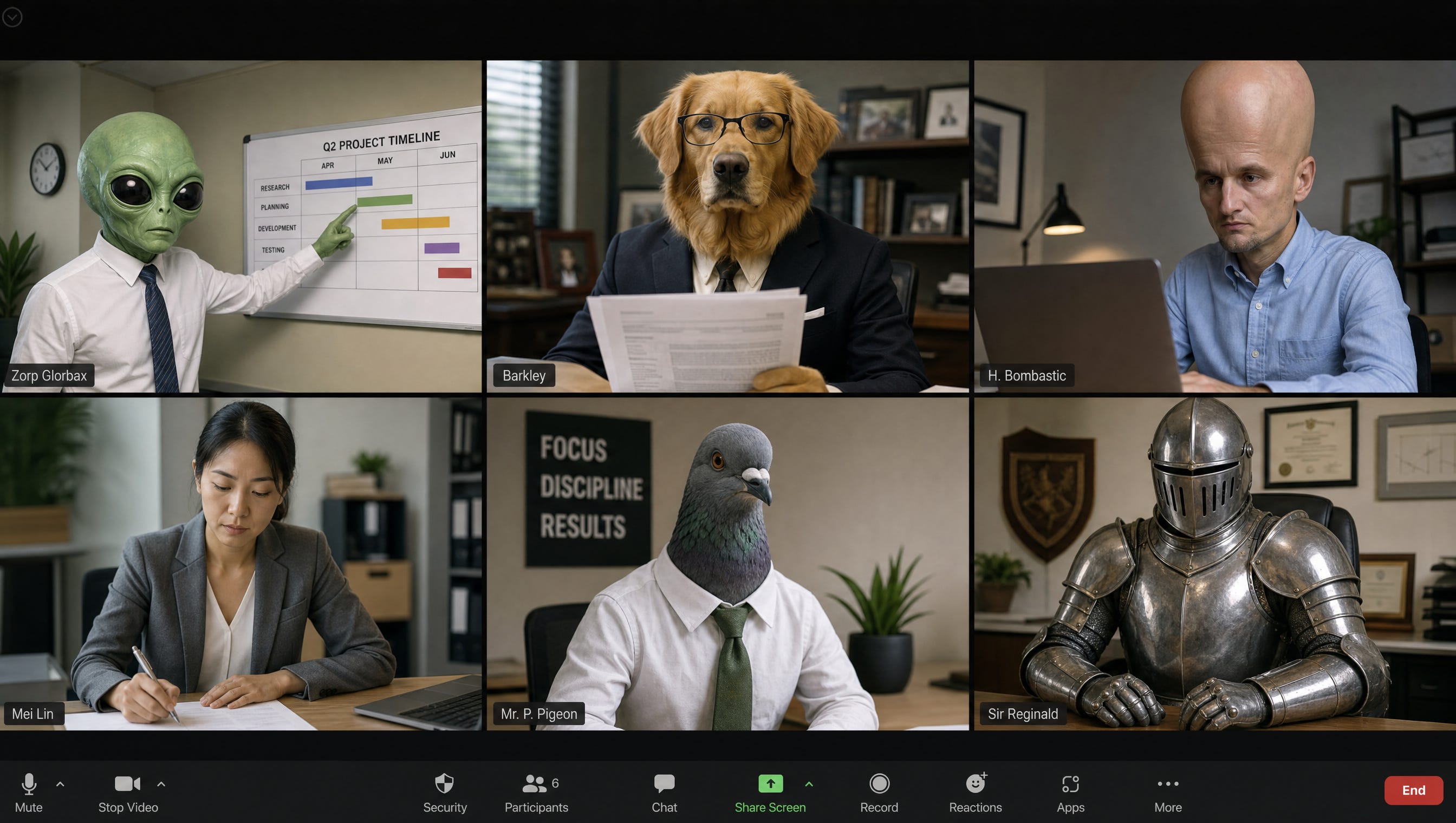
It started with video calls.
Think about what happens when you are on one. You are supposed to be focused on the other person, reading their face, picking up on their body language, figuring out what they actually mean. That is how real conversation works. You use the other person as your reference point.
But on a video call, there is a small box in the corner of the screen. And most people spend a significant amount of time looking at it. That box is them. They are using themselves as the reference point.
It sounds like a small thing. It is not.
That shift, from looking outward to looking inward, is a preview of something much larger that has happened to how we work. The format of how we communicate shapes what we actually transmit. By format, I mean the structures we have normalized: the video call, the AI summary, the distributed task list, the structured interview. Each one is efficient. Each one is also a filter. And what gets filtered out, consistently, is the harder stuff. Belief. Intent. The reason someone actually cares about where the company is going.
Now think about what happens after the call ends. The AI summarizes it. Someone reads the summary later, builds a framework from it, and executes. The machine runs. The deliverables get done. And if you could watch the whole process from above, it would look like a team moving in the same direction. But look closer. Nobody is looking at each other anymore. Everyone is looking at the box in the corner. Everyone is using themselves as the reference point.
Content makes it through the format just fine. Vision does not.
And here is the problem most companies are not naming out loud: the systems they have built, for hiring, for meetings, for execution, are very good at producing one type of person. The task completer.
Task completers are capable. They show up. They follow through. They clear the board. And right now, with AI handling more and more of the actual execution, task completion is becoming a commodity. Almost anyone can complete a task, or at minimum, manage the tools that do.
What is rare, genuinely rare, is someone who can take a vision and expand it. Not just execute on it. Not just protect it. But actually carry it forward, add to it, make it bigger than it was when it was handed to them. A vision carrier does not need every answer spelled out. They understand the why well enough to generate the how on their own.
So the real question is not whether your team is productive. The question is whether your team is actually inside the vision, or just adjacent to it.
And that starts at hiring.
Most hiring processes are optimized for task completers, because task completion is easy to measure. Did they do the thing? Yes or no. Vision, belief, intent, those are harder to see on a resume or in a structured interview. The format filters them out.
Which means if you want to find vision carriers, you cannot use the standard process to find them. You have to look for something different. The most useful question you can ask a candidate is not what they did, but what they were trying to build. And when something went wrong, did they fix the task or did they fix the thinking?
The difference between those two answers is the whole thing.
Companies that figure out how to identify and keep vision carriers will not just execute better. They will actually grow. Because growth is not a deliverable. It is not something you can summarize or hand off or automate. It requires people who are genuinely inside the idea, who feel the weight of where the company is trying to go, and who are willing to carry that weight even when the format gives them every excuse not to.
Most companies are hiring for one and hoping for the other.
I put together a practical framework for actually finding vision carriers in a hiring process — three lenses, the specific questions to ask, and what to listen for in the answers.
If this resonated, subscribe so you don’t miss what’s next.
And if you want the framework, comment VISION below and I will send it to you directly.
Tangential to the meeting problem: there's no way to make eye contact on a video call. There's a few AI solutions to this (nothing for mac interestingly), wondering how uncanny that feels. It's definitely something people kind of abstract without recognizing how core that is to human connection.